Showing posts with label Washington. Show all posts

Tuesday, September 30, 2008

RG's New Ford Sport Coupe

When the Old Routes were first built, it could be a rough route… mud, potholes, washboard, sand… cows, fences, angry horsemen, even gates to open. The cars weren’t much better, especially by today’s standards.

In our day of hot or cold beverage holders, entertainment systems we can talk to and GPS to guide us to the nearest Starbucks with a drive thru… it is very hard to picture what is was like to take a road trip in the early 20th century.

This picture might help. Late May 1930 R.G. Thompson had had enough of that ole Hudson Brougham. It was a pretty warm day, but he left his tie and coat on hoping the car salesman wouldn’t try to take advantage of him. He headed out from the Stock Exchange Building up 4th Avenue and uptown on Westlake to the William O McKay dealer. The Depression was tough and Eddie Pinkman was eager to make a sale. Too bad R.G. couldn’t get more in trade for the Hudson, but the sparking clean rust free Ford black paint clinched the deal. The Radiator cap added real style, too. Eddie didn’t get much commission for the sale. After all, he sold a new Ford Sport Coupe for only $679.25, but he was happy for the sale and happy to be working. As he headed back in the office, Eddie looked down Mercer Street at the closed Ford Assembly Plant wondering if it would ever open again.

Even though R.G. had to pay for the freight, oil and a tank of gas, he had a few dollars left for a couple of options.
-Spare Tire; at least it wasn’t one of those mini spares! You can’t have a spare without covering it and locking it up. Wise decision R.G!
-Bumpers, real steel bumpers, not those fiber-plastic bumpers we use now. Bumpers were protection for the car, and helpful to push someone out of the very common mud hole.

It was only a year into the depression, so he was conservative in going for solid steel wheels rather than those fancy spoke wheels. The seemingly unending Seattle drizzle and the unpaved roads keep the wheels covered in mud anyway. The temperatures are mild enough to go without side windows as well; after all, that’s what we have coats and hats for.

R.G. enjoyed his Ford for many years, driving up and down Pacific Highway US 99. Many times work took him to Spokane on the Sunset Highway US 10. On those hot summer days he watched that shiny radiator cap carefully for overheating. The cap would too often disappear in a cloud of steam as he headed up the steep hairpin turns of Snoqualmie Pass. Thankfully, if he had real mechanical trouble, he belonged to the Automobile Club of Washington (AAA). Since 1926 they had contracts with “reputable garages” to offer emergency road service for members.

A few years later, R.G. was one of the early managers for Centennial Flour Mills, which is still a major food company, based in Seattle. Besides being a far distant cousin, R.G. hired my mother-in-law as his secretary. Seattle was a much smaller town back then.

Some of this story is true, some is daydreaming. That’s the best way to drive an Old Route, enjoying what you see and also what is written between the double yellow lines.


Copyright 2008 Dan Smith

Monday, September 22, 2008

What the Sam Hill...?

There was a man named Sam Hill who believed in the future of good roads. You may have heard that exclamation of, “What in the Sam Hill…?” That was considered a polite substitute for using the word, “hell”, and came along before this Sam Hill was born.

Hill was a mover and shaker of the early 20th century, making millions in railroads. He knew royalty and other world leaders and traveled the world to learn about how to make good roads… but a darker side was that his home life was not idyllic.

Some of the projects that Sam Hill was behind include:
- The Pacific Highway from Canada to Mexico (US 99 and US 101)
- The Peace Arch on the US and Canadian Border
- Maryhill Museum
- Attempting to start a Quaker community called Maryhill
- Running a phone company in Portland, Oregon
- A copy of Stonehenge as a Memorial to Klickitat county soldiers who had died in World War I
- The Columbia River Highway (US 30)
- The first paved road in Washington State.

He was such a good roads advocate, the US 97 Columbia River Bridge was named after him. The bridge is within sight of Maryhill and the Stonehenge Memorial.

There’s too much of Sam Hill to put in one blog, so I’ll be writing more about Sam Hill and his love of roads, later.

Can't wait for the next Sam Hill blog? Read your own Sam Hill book. The Prince of Castle Nowhere or Sam Hill's Peace Arch.

Links
- Maryhill Museum on Sam Hill
- Sam Hill from HistoryLink.org
- Where the Sam Hill is Maryhill?


Saturday, August 9, 2008

Where did the US Route Shield come from?

You can trace the roots (not routes) of the US Route shield to the founding of our country. Before it adjourned on July 4, 1776, the Continental Congress of the newly independent United States passed a resolution:
Resolved, that Dr. Franklin, Mr. J. Adams and Mr. Jefferson, be a committee, to bring in a device for a seal for the United States of America.
It wasn’t until 1782 that they came up with the final version of the seal. It has changed slightly over the years. You probably may and handle it every day as both sides of the seal are on the back of the US One Dollar Bill.
The US Route Shield was modeled after the shield in front of the eagle. Some earlier versions of the seal shield look even closer to the route shield shape.
Part of the logic of the new roads was to have a national numbering system that was consistent state to state, and as part of that the signs should be of similar shape and standards as well.
Along with the numbered shields, there were also smaller shields with only an “L” or “R” noting which way to turn at an intersection to stay on the route.

When they first start posting the US Routes in the 1920’s there were very little signage even noting road names or even where they went. When Dr. Horatio Nelson Jackson and his his co-driver Sewall K. Crocker, went on the first coast-to-coast road trip in 1903, even when they had a road to drive on, they spent much of their time lost going down the wrong roads.


The shield itself hasn’t changed in shape much, but what is inside has. The “font” of the numbers has rounded over the years. Before reflective signs came into being, small round reflecting eyes were used to ease viewing at night. Slowly the US or the state name disappeared and so did the line dividing the top and the bottom. There were even some more colorful versions to help direct drivers to different cities.
Today, US Route signs are very simple black numbers on a white shield. Depending on the use, sometimes it’s a square black background, or cutout and place on a larger green sign. Always with style, California cuts out the sign to the shape of the shield.

For State Highways, there are all sorts of versions. A common one is the use of the shape of the state or the state seal as the outline.

UtahThe Beehive state of Utah, uses a Beehive.
Washington StateWashington uses an outline of George Washington’s profile.
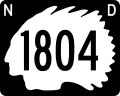
North DakotaNorth Dakota uses an outline of an Indian chief.
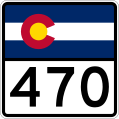
ColoradoColorado uses their state flag.

Less creative is the use of geometric shapes like a square or circle.


Many state shields have evolved over the year as well. Oregon used the fancier outline of their state seal until they modernized to the simpler looking shape.


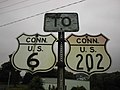
If you are a road geek of sorts, you have probably enjoyed finding an old original US Route sign on a decommissioned highway. This happens fairly often by accident or omission as they are left behind. Often the old US route number remains as a state highway number, so I guess they can save a few bucks by leaving the sign behind.

Some overhead intersection signs in the Portland suburb city of Tigard, Oregon were recently changed on old US99W. This is now state highway 99W. I noticed it wasn’t the state shape, but it wasn't the US Shield either. They used a fully white Interstate Highway shield. Well, I think someone had a nice historical thought anyway. *

We have t-shirts, hats and other "shielded" items an our Old Route Souvenir Shop.

If you know where an actual old US Route shield remains on a former or decommissioned US Route, please write me at OldRoutes@gmail.com.
If you want to know even more, check out http://www.us-highways.com/ussign.htm from Robert V. Droz.
See all the State Route Shields at http://en.wikipedia.org/wiki/Wikipedia:WikiProject_U.S._Roads/Shields/Database

Get your own realistic US Route Sign.


*99W sign in Tigard Oregon, Copyright 2008 Dan Smith

Wednesday, May 21, 2008

My Driveway was US 99

As part of the Smithsonian’s America on the Move exhibition, they brought an original 1932 piece of Route 66 from Oklahoma to the Smithsonian in Washington DC. I was able to enjoy several hours of the wandering around the history. Among all the people rushing through, I stood there for a moment and thought of the people that traveled this road. What kind of car were they in? Were they a family enjoying a trip, or maybe looking for a new life out west? How many times had the kids impatiently asked, “Are we there yet?” Was Dad trying to put just a few more miles behind him tonight? Was the tired driver worried about that funny sound or whether that temperature gauge will ever go down?
You can get a virtual tour of the museum here and buy the official book here. The Museum has been closed for major architectural renovations. It’s scheduled to reopen November 21, 2008.

While old US 99 doesn’t have the “curb appeal” of Route 66, some folks in Kelso Washington have a leftover stub of old US 99 or Old Pacific Highway as part of their driveway.
I suppose they aren’t a road geek and just think it’s a big old piece of concrete, but there could be some interesting decorating. Some Burma Shave Signs… a nice 99 shield on the mailbox… a sign proclaiming the end of 99 ahead… No Passing?

There are many unimproved miles of the original 99 in Southwest Washington. Some even have the original killer concrete posts. If you would like to drive it, check out this article from the Columbia River Reader newspaper, but be careful out there.

Have you found any interesting pieces of old routes around? Let me know at oldroutes@gmail.com.